
Castro Theatre Team Reinvents a San Francisco Icon
Article by Scott Blair, Editor-in-Chief - Engineering New Record
After serving as the cultural heart of the Castro District in San Francisco for more than a century, the Castro Theatre, originally built as a movie house, was beginning to show its age by the mid-2010s. Dirt and years of cigarette smoke coated the ceiling, and the plaster was decaying. Ill-advised repairs after the 1989 Loma Prieta earthquake put architectural elements at risk. The building lacked HVAC and full ADA access, and the pandemic, competition from streaming services and modern cinemas caused dwindling attendance.
Now, a $41-million effort to bring the facility back to its former glory—and in some ways surpass it—nears its February 2026 debut. While the saga to transform the theater from movie house to multi-purpose venue has not been without drama and plot twists, clever workarounds have helped the team push through roadblocks.
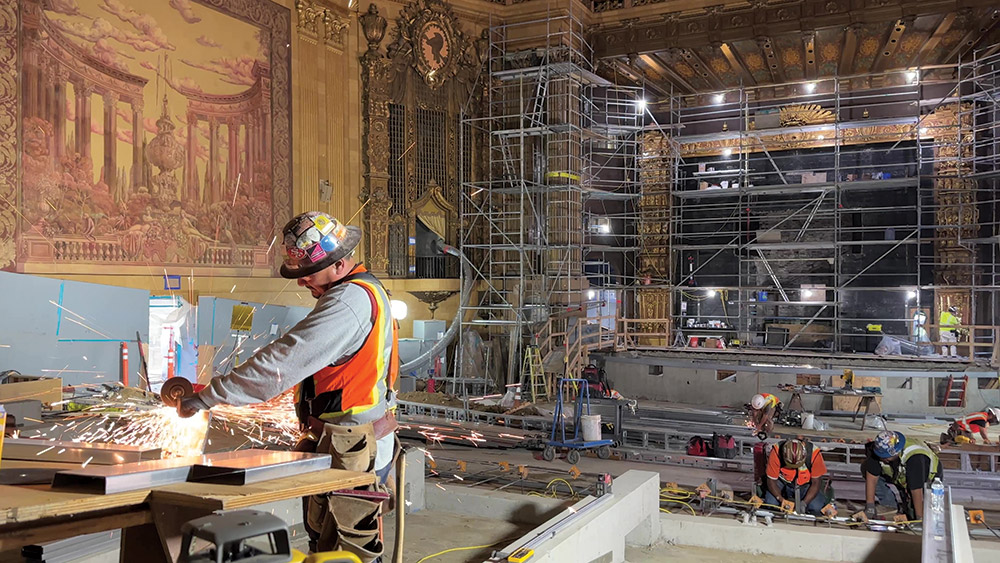
A sgraffito mural required little restoration, while the proscenium (right, scaffolded) that lay hidden behind a movie screen for many decades needed more than a month of cleaning and re-gilding work.
Photo by Scott Blair/ENR
Twists and Turns
The Nasser family, who have owned the Timothy L. Pflueger-designed theater since it was built in 1922, brought in architect Page & Turnbull and restoration specialist EverGreene Architectural Arts in 2017 to assess the structure around the same time it started to become clear that the repertory film business model wasn’t sustainable. While the exterior of the steel-and concrete framed building evokes Spanish Baroque and Beaux Arts architecture, the interior features Italian and Art Deco influences, including an ornate chandelier and other touches that Pflueger himself added in 1937 after an electrical fire damaged the interior.
“The first thing we did was a forensic investigation, a finishes analysis and assess the substrate of the plaster,” says Jeff Greene, chairman and founder of EverGreene. One of the first surprises Greene’s investigators found was that it wasn’t just dirt and cigarette smoke that obscured the elaborately painted ceiling.
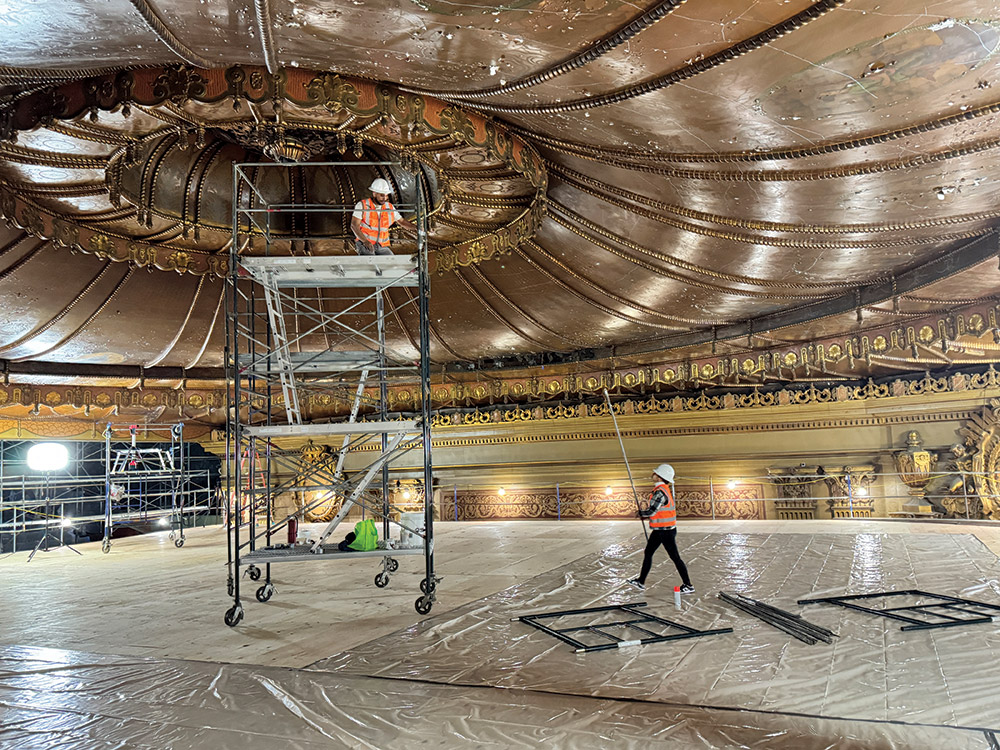
Restorers worked on cleaning the ceiling for several months.
Photo courtesy Alarcon Bohm
After the Loma Prieta earthquake, “somebody got up there and scraped off a lot of paint and put a dark, muddy polyurethane on top of it, which had cross-linked and darkened incredibly,” Greene says. “Part of the reason they did that is to hide a multitude of sins that you really couldn’t see because of how bad it was, because of this turbid, darkened varnish over everything.”
Around the same time as the theater’s lengthy pandemic closure, a local independent concert promoter, Another Planet Entertainment (APE), had been looking for a space to lease around the same size as the theater’s 1,400 seats. “Once we came in and met with the owners, it took about a year to get the final contract resolved,” says Mary Conde, senior vice president of production at APE. “We wanted to create a space where you can be a successful repertory film house and show popular music, have drag shows, podcasts, comedy shows and all types of entertainment.”
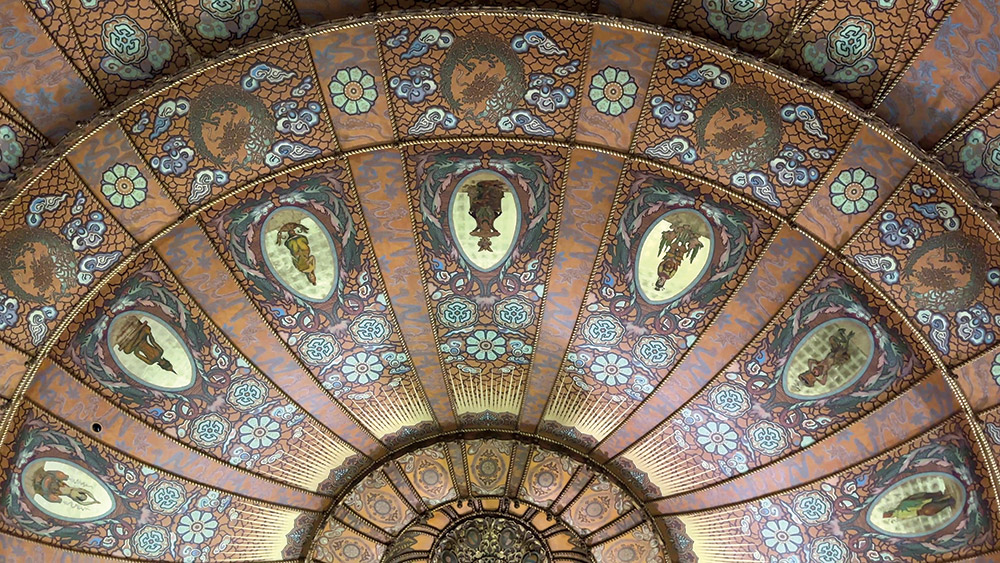
The ceiling after restoration.
Photo by Scott Blair/ENR
APE enlisted CAW Architects to lead the design. “The building has great bones, but it needed a lot of TLC,” says CAW project manager Keith Wainschel. “Early on, we were really looking at, what are the key points that we want to hit if we’re going to renovate this building?”
A 3D scan of the building captured all of the ornate details and decorative work, and was converted into a Revit file. “That became our working file in 3D,” Wainschel adds.
Construction began in early 2024 with local contractor Alarcon Bohm setting up scaffolding around the famous blade sign to remove loose lead-based paint and then prep it for new paint and all new neon lights, says President and CEO Kevin Bohm. “We also put a new sheet metal ‘hat’ on top of the sign, because it was all rusted out after being here 100 years.” New guide wires strengthened the integrity of the sign, and the marquee was similarly upgraded. All of the exterior facade work was completed in time for a neighborhood Juneteenth block party in 2024.
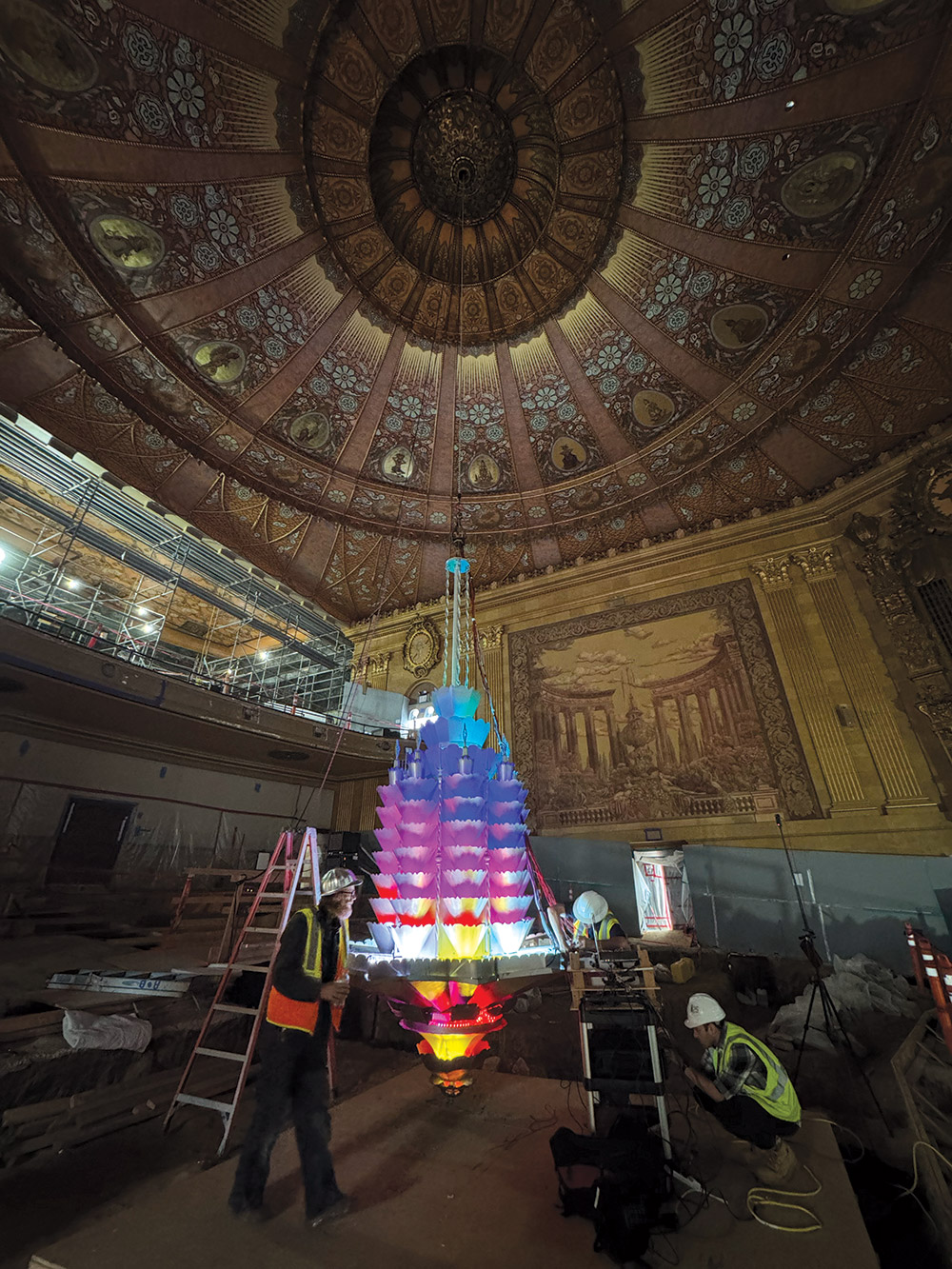
The 1937-era chandelier was restored and fitted with modern LED lights.
Meanwhile, interior construction sequencing occurred in reverse of a normal build. “On most projects you’ll do finishes last. On this project, we set up scaffolding to enable the restoration of the ceiling and the walls first, and then during the process, we were able to get a demolition permit to do the demo early on while they were still doing restoration,” Bohm says. Protection was installed so that construction could occur without damaging the restored finishes, and the theater was placed under negative air pressure to minimize dust during excavation for conduit and utilities that had to run under the floor since the historic walls couldn’t be opened up.
Even small repairs to the walls required extra care. “Every time we have anything that needs to penetrate any one of these vertical surfaces, we have to do abatement to deal with the lead paint and the asbestos before workers can actually do their work,” Bohm says. In-house environmental crews performed spot abatement “to open it up under containment, do the abatement, encapsulate it and then enable the work to be done.”
A jungle of scaffolding occupied the main theater floor for around six months to enable a crew of 10 restoration experts to tackle the challenging plaster ceiling. But they weren’t restoring it to the original 1922 look. “The goal was to leave some of the patina on here so that it looked like a historic theater that’s been well preserved, not different layers done at different times by different decorative campaigns,” says Greene.

Rondelles before and after painstaking restoration.
Photo courtesy APE
It wasn’t until engineers got up behind the ceiling that they noticed “that we could see light through these big gaping holes” in the plaster, up to 1 ft by 4 ft in size where the plaster had fallen, says David Mar, partner at Mar Structural Design. The ceiling also had been retrofitted after the earthquake with a “jury-rigged additional bracing” that had to be disconnected from the diagonal members of the long-span trusses, he adds.
Restorers took a three-pronged approach: “preserve, conserve and replicate where things were too far gone, and then blend all of those into a kind of cohesive visual effect,” Greene says.
The outer ceiling design is divided into 16 quadrants. For the wide sections featuring blue rosettes, the team replicated the design on canvas and then installed them over the top of the original to protect the original plaster. However, each of the 16 oval rondelles were unique, so EverGreene took a purely conservation approach to those. “We reattached loose paint because it was being pulled up by the surface tension of the polyurethane,” Greene says. “It was possible, but very tedious, to remove the polyurethane. The problem was that removing it over the whole ceiling did more damage, but for those 16 rondelles, we were able to use a small packing iron about the size of your thumb, and heat and relax those brittle flakes of paint.” A syringe placed adhesive behind it to consolidate and pack the paint back down. Once the underlying paint was secured back to the plaster, the varnish could be softened and removed, “square inch by square inch,” Greene adds.
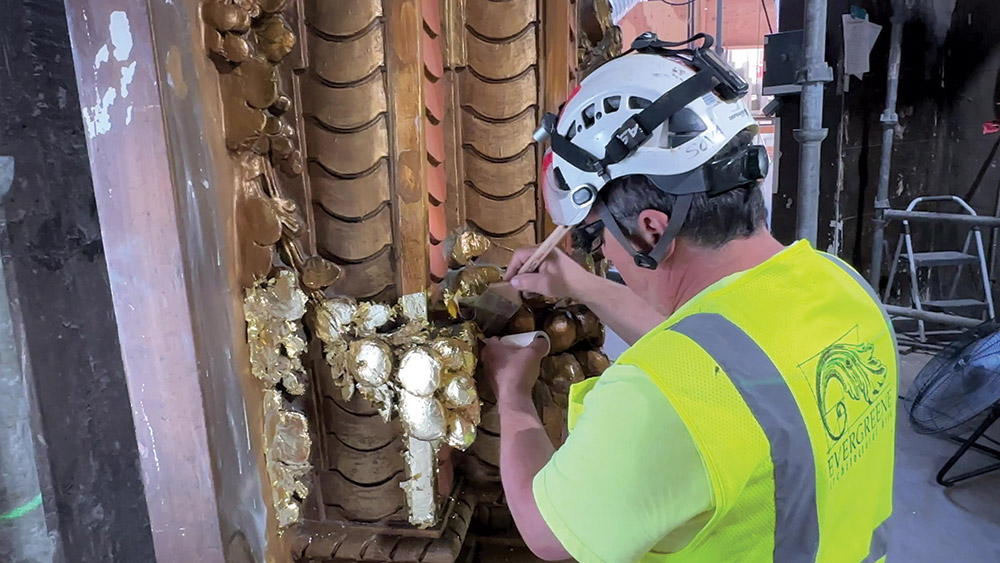
A conservationist adds gold leaf gilding to the cleaned and patched proscenium.
Photo by Scott Blair/ENR
In one stroke of good luck, restorers found that the center-most ring of the circus tent-like ceiling had none of the polyurethane, so it could be cleaned using less laborious methods. “That was an ‘aha’ moment,” Greene says.
Another surprising discovery added a significant chunk of restoration work. Once demo crews removed the old movie screen that covered up the back of the stage, they discovered a long forgotten ornate proscenium. “It solidifies the intention of the design that this building is meant to have curved edges—there aren’t a lot of right angles,” Conde says. “We kept those curves intact. And [the proscenium] really makes the whole design much more cohesive.”
But it meant an additional, unbudgeted 45 days of restoration work. “We’ve done a full deep clean, which includes dry cleaning, brushing with vacuums and sponges and then a chemical cleaning with a pH neutral cleaning solution,” says Samantha Emmanuel, an EverGreene conservator. Next, any cracks are repaired and the surface is repainted and gilded with gold leaf.
The 1937-era chandelier was restored and upgraded to modern LED lighting by Phoenix Day Lighting, the same firm that originally built it. The world’s largest symphonic organ will be another striking upgrade, which will rise up through a slip stage. The installation required around 6 feet of additional excavation in the orchestra pit to accommodate a new lift system.
Crews also had to more than double the electrical service to the theater to accommodate additional power needs, which required an unplanned trench to a new PG&E transformer across busy Castro Street. “Even though there’s as-built drawings for how utilities were done in the past, we find surprises almost at every turn,” Bohm says. The street and sidewalk work must also minimize impacts to adjacent businesses and allow free mobility for pedestrians and transit while relocating other utilities such as water, communications and sewer lines.
In an effort to ease the burden on the surrounding area, “Some of the things that we did initially was to do a lot of community outreach and making sure the neighbors and retail shops were comfortable with us coming in,” says Christine Harris, Alarcon Bohm project manager. “We’re always going to be collaborative, involved. We always pick up our phones if one of the retail shops or a neighbor has a complaint.”
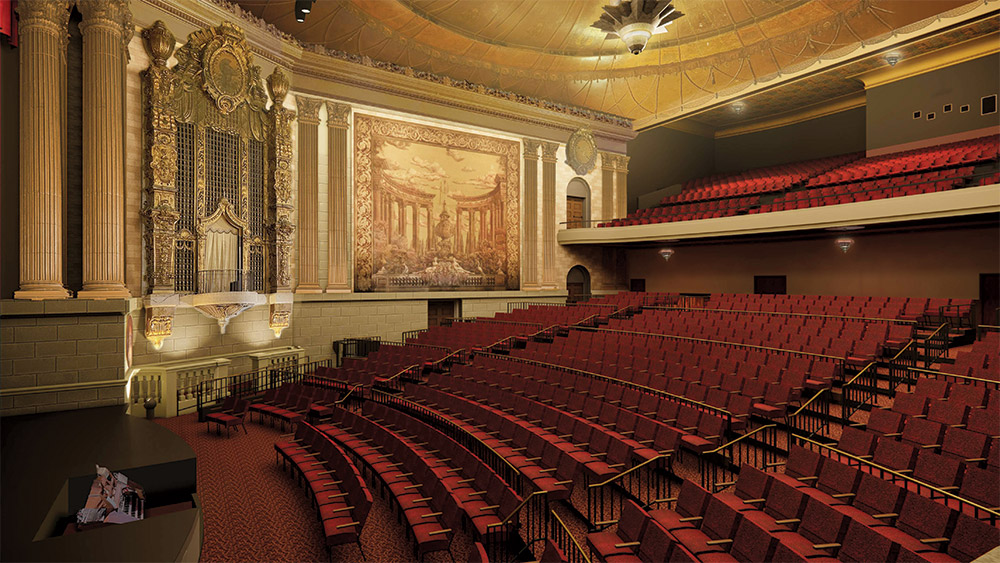
New seating scheme includes removable seats with trundle bed-style seating platforms that slide away to create standing-room tiers.
Renderings courtesy CAW
Much Ado About Seating
When APE’s multipurpose plans were first announced, while most people supported the revamp and economic need for more flexible seating, some in the Castro community balked at the conversion of the seated movie house to include a more open, standing option. The dispute at times became contentious. “I’m trying to save a landmark, and people literally went to City Hall and booed,” Greene says.
The compromise to satisfy both camps “is not a simple thing—it’s probably one of the most complicated things about this project,” Wainschel says. The steep movie theater rake would not work for concerts and prevented wheelchair access to all but the very back of the venue. Seats will now be removable and can be stored in a new back-of-house space—the only additional space in the entire project. Then, a system of steel-framed seating risers, each about 6 in. high, can be retracted like a trundle bed using a series of casters into cavities behind the next higher level, which will create five standing-room tiers for concerts. “Even though you might relate this to a set of like telescoping bleachers, it’s totally custom to this space,” he adds.
To see if the building could accommodate additional loads prompted by music fans jumping around, Mar says the structural design firm “did a lot of analytical work to verify its capacity based on stadium loadings,” along with “a lot of vibration work that wasn’t really necessary [for] the original [1922] construction.”
The ‘trundle’ cavities also serve as the pathway and plenum for the new air system, with gaps that allow conditioned air to flow at a very low, quiet velocity.
The new HVAC units sit on the roof, but the supply ducts run down the outside of the building and re-enter beneath the floor, so as to not puncture the historic walls. The new power conduit similarly runs up the sides of the building to the roof. To support the additional weight, a new structural steel frame was added to the roof, connecting to the exterior walls and existing long-span trusses. It penetrates through the roof into the attic to support upgraded speakers and light rigging, which required “getting some big steel into a really tight space,” says Nick Colina, CFO at Anco Iron & Construction Inc., which had an approximately $4-million structural steel package on the job. The site, hemmed in on all sides with other buildings except for a small parking lot in back, also posed challenges for the large crane needed to fly the steel, he adds.
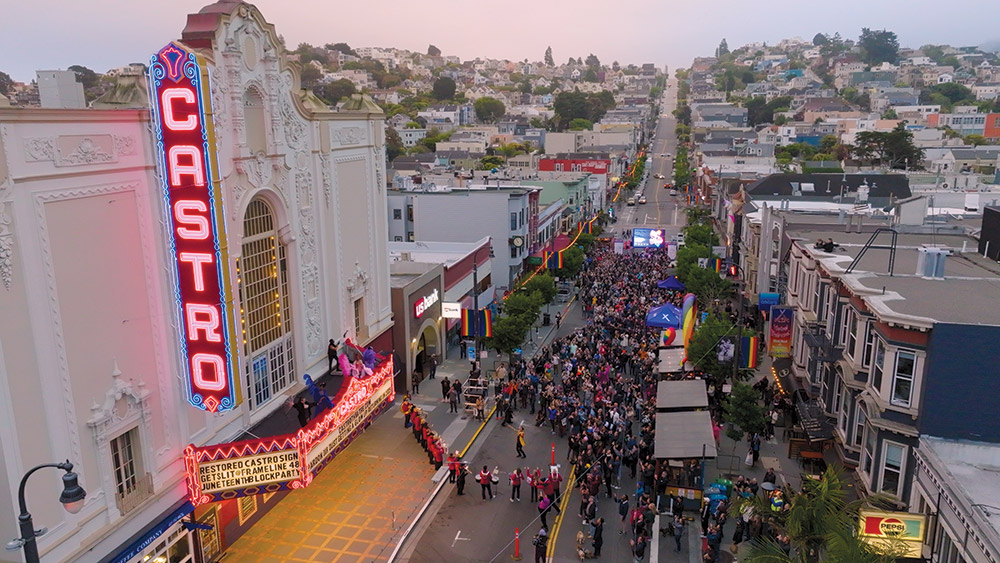
Exterior renovations were unveiled during a 2024 Juneteenth celebration.
Photo courtesy APE
Anco is one of several Bay-area firms that APE and Alarcon Bohm contracted with via a unique partnership with BuildIT, an industry association dedicated to the sustainable growth of LGBTQ and allied businesses. Community involvement was key to APE given the theater’s status as “the epicenter of LGBTQ culture in San Francisco, and probably the world,” Conde says.
The project gave BuildIT associates the opportunity to demonstrate our ‘qualifications and price-matters’ approach to the marketplace,” says Paul Pendergast, BuildIT’s president. The group “provided the technical assistance services needed to support our associates in being competitive in the procurement phase but also successfully deliver their respective scopes of work on-time and on-budget.” He estimates that north of 35% of the overall construction value of the project went to associated firms. “It was a testament to building in this community” and making sure “LGBTQ businesses and minority local businesses are getting an opportunity,” Colina says.
Rebranded “The Castro” when the curtain raises on the restoration with a two-week opening stint by musician Sam Smith in February, the project team hopes the grand reveal will exceed the community’s expectations. For Bohm, “this has been the honor of a lifetime to be able to be in charge of such an icon.”